You realise you're afraid only when it happens again
Have you ever watched someone die? I haven't, yet I have. I have not watched someone die with my own eyes. It did not happen on screen. Yet I did experience it. It's not the moment it happens that's scary. It's the uncertainty afterwards, the seconds or minutes when you aren't sure if they're alive. It's something that only becomes truly horrifying when you have experienced the bad ending before. When you are aware deep inside that the worst can have happened. When you truly know what that means. I will never be able to look at a crash the same way again, and I only realised it once it happened again.
This story starts in the early morning of March 21st 2004. I was 6 years old. When I was that young, I would regularly wake up at 6am and not be able to fall asleep again, so I'd go downstairs and turn on the television. It'd be too early for regular programming, so I'd often watch sports. Eurosport would always be broadcasting after all. Once I watched spirited away at 6am. On this faithful day I turn on the television and the event which happens to be on is the Formula One 2004 Malaysian Grand Prix. I immediately think it's the coolest thing ever. I liked cars, but these cars looked incredible and they were going so fast and doing all these crazy racing maneuvres. I have not missed a race since. For over a decade I was able to enjoy Formula One in a carefree way. I could root for my favourite drives. I could see a crash and think it was exciting because it would cause a safety car and mess with the race. It was always fun to watch. I'd get happy when my favourite drivers won, and upset when their engine would blow up. I witnessed some of the most magical seasons in the history of the sport, like 2007 where three drivers fought for the championship in the final race and the most unlikely candidate won. Rainy races were always the favourites. They still are. Rain causes chaos, throws all established strategies overboard, and makes it so the best drives float up towards the top.
Something could've happened to Adrian
We move forward ten and a half years. 5 October 2014. I am once again in front of the tv at 6am. This time to watch the Japanese Grand Prix. Mercedes are the dominant force this year, having built a car so much better than everyone else that it would take 6 years for anyone to catch up. But this race wouldn't be boring. Thyphoon Phanfone had reached Japan, and heavy rain was falling on the Suzuka circuit. The race started behind the safety car under wet conditions, was red flagged a couple laps in, and restarted 20 minutes later when the rain had died down a little bit. The first 41 laps of the race are unimportant. They don't matter, not anymore.
Details in cursive are ones I did not remember clearly, but which shaped my reaction to the events unfolding
On lap 42, Adrian Sutil crashes his Sauber in the Dunlop curve after aquaplaning off track in the wet conditions at about 220km/h. A replay of the crash is shown, but Adrian isn't shown getting out of the car. Surprisingly, the safety car doesn't come out, and the race continues. Jenson Button makes a pistop from 5th position so commentary focuses on that. A minute later, a shot is shown of Sutil's car being lifted by a crane with some marshalls around it, followed by a long shot of his mechanics looking at each other not doing much. Shots of mechanics after crashes are common, usually you see their disappointed initial reaction. Shots of them just looking at the screen looking desperate are more common after serious incidents. On lap 44, race director Charlie Whiting finally brings out the safety car. The medical car comes out on track to make its way to the site of Adrian Sutil's crash. Although he's out of the car, the commentators assume he could be injured from the force of the crash. No other footage of the incident or the scene is shown, which is usually a bad sign. It's customary to not show replays until it's confirmed the driver is okay. The feed shows the Marussia mechanics watching the race unmovingly. Then they come in with a shot of two medical cars at the scene of Sutil's car. This is when I get seriously worried, when I start shaking. I was talking to someone online at the time, who didn't understand why I was so worked up. "Something could've happend to Adrian", I remember myself sending very vividly.
I don't recall when I learned it wasn't Adrian. Looking at the feed, a shot is shown of the crash site with a name tag on screen: "17 Jules Bianchi, Marussia Ferrari". The BBC commentators don't notice it. I don't remember if the German commentators noticed. This was in the weird couple of years where F1 wasn't televised for free in the Netherlands and we had to watch RTL Deutschland. Being German, I assume they focused on Sutil, a German driver, as well. My German was worse than it is now, and it's still not fluent, but the name tag and following shots of the Marussia garage probably shifted my worries. At this point I'm worried about both drivers, not having any idea what happened but knowing it's serious. I don't think me and my dad exchange many words. The BBC pit reporter mentions Bianchi's involvement, but when "Ambulance on track" shows on screen she still assumes it's for Adrian. Only now does the race director throw the red flag and ends the race. I immediately use the family computer to open r/formula1, hoping to find any type of explanation. The commentators are still unsure what happened. Lewis Hamilton wins the grand prix but does not celebrate. There is no champagne on the podium. I keep francticly looking for news on if Adrian Sutil and Jules Bianchi are okay. What I find will stay with me for the rest of my life.
JB17
Photos show up on reddit and assorted F1 news websites, and it becomes clear what has happened. Whilst the recovery vehicle was on track to retrieve Adrian Sutil's crashed car, Jules Bianchi lost control of his Marussia and went off track in the same corner. The recovery vehicle is a crane on high tractor tires. The front of Bianchi's car goes under the truck. His head doesn't. He collides head first with the tractor at a 55 degree angle at 123km/h, sustaining a force of 254g. He is knocked unconscious instantly. He never regains consciousness. After being extracted from the vehicle, which is missing the entire overhead air intake and rollbar section, he is airlifted to a local hospital, where he undergoes brain surgery.
Bianchi is still in coma when the Russian Grand Prix takes place a week later. Marussia elect to only enter one car for the weekend. Bianchi's car is placed in his garage with stickers reading #JB17. All drivers compete with a sticker saying "Tous avec Jules" on their helmets. Marussia's sole remaining driver Max Chilton, famous for finishing the first 25 races of his career, retires from the race after 9 laps with a suspension issue. After the weekend, the team enter administration. They don't compete in the final three races of the season.
Adrian Sutil watched the whole thing happen, something which will mark him for life. He was watching the entire time whilst marshalls and medics alike were attending to Bianchi right after the crash, unable to look away. After Sauber dropped him at the end of the season, Sutil retired from motor racing altogether. He realised that in the grand scheme of things none of it mattered. He did not want to be there anymore. And I can only be fully understanding of that decision.
I am in a hotel room somewhere, I don't even remember where, on 17 July 2015 when Jules Bianchi passes away at age 25 after half a year in coma. At the time of his crash Bianchi drove for a backmarker team, but he was part of the Ferrari driver academy and was rumoured to succeed Kimi Räikkönen at Ferrari for 2015. Instead he became the first fatality during an F1 weekend since Ayrton Senna in the 1994 San Marino Grand Prix, one day after Roland Ratzenberger lost his life in qualifying for that race. Formula 1 seemed safe. It was safe for over 20 years. Now that we know it can still happen, who is to say it won't happen again?
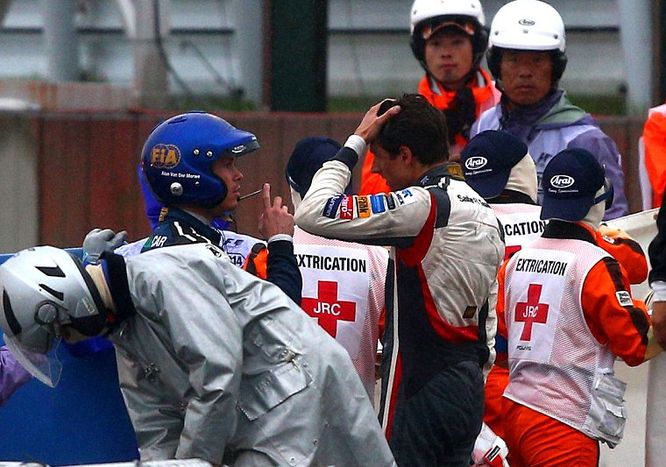
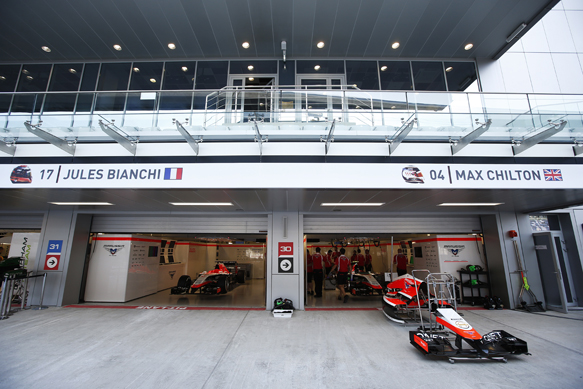
Left: Adrian Sutil lost between the medics tending to Bianchi. Right: Bianchi's car in an empty garage at the Russian Grand Prix.
The Phoenix
It's always when you have nearly forgotten that you are reminded of what you are actually watching. The day is 29 November 2020 and everyone is sitting at home during the Covid-19 pandemic. At the end of a shortened and improvised Formula One season the circus makes its way to Bahrain for two races. The regular Bahrain Grand Prix would be followed by the Sakhir Grand Prix, driven on a different track layout. Everything is fine until turn 3 of the first race. Romain Grosjean, veteran driver and serial incident causer, cuts across Daniil Kvyat's AlphaTauri car but clips Kvyat's left front wheel with his rear right. Grosjean spins off towards the barrier in what looks to be a common accident until his car explodes in a giant fireball. I was watching this on the couch with my then girlfriend. I remember yelling "FUCK!" followed by a deathly silence. The red flag is flown within seconds, stopping the race. No one is thinking about the race anymore. Seconds feel like minutes. I am taken back to 2014, that horrifying uncertainty when you know something is very very wrong. The feed cuts away to anything else it can find. An onboard of one of the other cars shows the large plume of smoke in the distance. I have not breathed in years. After the longest 30 seconds of my life, a figure is shown leaping from the flames, arms spread, towards the medical car. I breathe out.
Only after a while does it become clear just how close Grosjean had been to death. On impact, his car had gotten wedged in the barrier itself and broken in half, rupturing the fuel tank and causing the fireball. The way the monocoque was stuck in the barrier prevented him from being extracted. Grosjean would later say in an interview that he had spent a couple seconds making peace with his own death, before thinking of his family and decided to try and climb out of the car. Miraculously, he was conscious after the 67g impact, and the managed to wedge himself between the halo, (a safety device covering the cockpit introduced after Bianchi's death) and the deformed barrier to climb out of the car. He was in the fire for 28 seconds, and managed to survive because his helmet had prevented him from breathing in smoke. Grosjean survived with only second degree burns on his hands and a broken rib. The incident earned him the nickname "the phoenix".


Left: The moment of impact as shown live on television. Right: Romain Grosjean, the Phoenix, escapes from the flames.
You realise you're afraid only when it happens again
Interestingly, the Grosjean crash was not when I realised how much I had been affected by the Bianchi accident. At the start of a race, the camera customarily follows the frontrunners after the first turn. This means the rearmost cars are off screen for most of the first lap. This was no different at the 2024 Monaco Grand Prix, where everyone got through turn one fine and we were watching the first cars making their way past the casino as the red flag was immediately thrown out. This is when I started holding my breath. No footage of the incident, just the cars slowly making their way through the swimming pool chicane under red flag conditions. This is when I realised I was shaking. Then a shot of a wrecked Red Bull Racing car on the hill. Your thoughts go to all kinds of places, most of which can be summarised as "please, not again". It's that fear of the unknown. Those moments where you know something is severely wrong, but you have no further information. And you know, you have experienced before, just how wrong it could be. And you are terrified of it. It really didn't take long for the feed to show Sergio "Checo" Perez climbing out of his car unharmed. The two Haas F1 cars also involved in the crash were considerably less damaged, and the drivers had already gotten out. It turns out nothing was actually wrong. No one sustained any injuries. But for a minute, we didn't know that. All we knew was that something was very wrong. It's only when nothing is wrong that you realise how much the knowledge of what it's like when it really goes wrong affects you. This is when I realised the impact Japan 2014 had on me. And I know that the next time a red flag comes out immediately following a crash, I'll experience it all over again.
Formula 1 is a very safe sport. Whereas drivers died regularly in the 70s and 80s numerous safety improvements have made fatalities exceedingly rare. They hadn't happened in years before Imola 1994. They hadn't happened for two decades before Jules Bianchi. It'll probably be a very long time before it happens again. I have seen all sorts of horrifying accidents where drivers were able to just climb out of the car and walk away. That has become the norm. Formula 1 has considerably fewer injuries than any other popular sport. You'd almost forget that racing cars is inherently dangerous. And that's a good thing! It means it's safe enough that we aren't really confronted with it regularly enough to pay the danger any mind. You'd probably be afraid of death constantly whilst watching an F1 race in the 1970s. Nowadays thre is no need to be afraid. And you only realise that once it happens again.

First shot of the 2024 Monaco Grand Prix first lap accident scene shown on TV during the red flag
CONTENT WARNING: THE FOLLOWING IMAGE CAN BE SHOCKING
.
.
.
.
.
.
.
.
.
.
.
.
.
.
.
.
.
.
.
.
.
.
.
.
Adrian Sutil was able to watch Bianchi's eyes close after the crash. The visor was opened by the force of the crash.